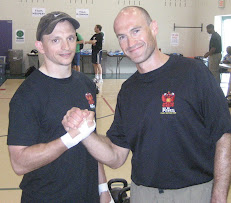
Tuesday, December 22, 2009

Omaha Personal Trainer Injuring Clients with Kettlebells

Today I learned of yet another individual injured through kettlebell by a personal trainer attempting to teach kettlebell techniques. Sadly I've heard three first hand accounts now of people being injured by the exact same trainer.

While in the weight room I struck up a conversation with a man performing kettlebell sumo deadlifts. Our discussion began with deadlifting then progressed to the kettlebell swing. I asked if he had considered the kettlebell swing as an assistance exercise from improving the deadlift. His response was he already tried that but was not satisfied with the results. The moment he demonstrated his kettlebell swing I knew that the problem was not program design it was poor technique. When I demonstrated the RKC hardstyle swing his eyes grew wide and immediately he acknowledged that this was a much more useful, explosive and therefore functional movement than he was taught. As we spoke he told me of his experience with a group kettlebell class lead by a personal trainer...
  • In his class a man was made to perform 45lb getups during his first kettlebell session without a spotter. The trainer was telling him that as a man he should be able to use even more weight so not being able to do a 45lb getup was inexcusable. Inevitably he lost control of the kettlebell and injured his shoulder.  This individual was out of commission for months due to his injury that was a result of an irresponsible or ignorant trainer.
  • During the very same class another individual described as a thin man who was new to weight training was made to swing a 45lbs kettlebell forcing him to lose control as he was pulled forward by the weight and force of the swing. This is an obvious sign that the instructor did not screen the client's movement patterns. The client was lifting his heels and jutting his knees forward. 
  • The individual that told me the story is a very strong man. He was also made to do getups on day one with a 45lb kettlebell on his first attempt, without a spotter. He recalled how shaky his technique was and how he was worried about dropping the weight. He knew his technique wasn't good enough for that amount of weight, especially without a spotter.
All three of these scenarios illustrate yet another personal trainer who has not been trained how to teach or progress a client safely. Giving a kettlebell or worse, giving a heavy kettlebell to someone that has not first demonstrated safe movement is like giving a child a loaded gun. Kettlebells don't hurt people, but bad trainers will definitely hurt people with kettlebells.

If this sounds like your experience with a personal trainer teaching you kettlebell techniques, stop immediately.
Just because some is a certified personal trainer does not mean they know how to teach kettlebell techniques, in fact most personal trainers have never been taught how to use a kettlebell, even fewer have ever been taught how to teach kettlebell techniques.

If you are serious about learning kettlebell do yourself a favor and seek out an RKC instructor. RKC Instructors have demonstrated a high level of skill and fitness with kettlebell techniques. RKC instructors have been taught specifically how to teach kettlebells techniques, and more importantly how to teach correct  movement before putting a kettlebell in someone's hands. RKC instructors have a large toolbox of corrective drills that will enforce safe and correct movement.

If you are in the Omaha area give me a call (402) 850-5551. As an RKC I will start by teaching you the swing and getup then progress you to more advanced techniques. I will teach you according the methods taught in the RKC system. You will learn safe technique using logical progressions before you earn the right to use weight. Your body will be given time to adapt to the strain before you advance in volume and intensity.  This may take a few sessions or a few months, but I can guarantee you will become stronger and healthier. The RKC methods will make you a better man, even if you're a woman ;).

Monday, December 21, 2009

Pistol Progress

Completed Several Body Weight pistols today without a counterbalance.
I stacked up 8 aerobic step risers and performed 5 pistols each leg. I did not allow myself to rest when I touched the riser, instead I immediately stood up.

[ Here I am coming out of the bottom position today]


Each set I removed one riser.
5 / leg at 7 risers
5 / leg at 6 risers
5 / leg at 5 risers
3 and 2 / leg at 4
2 , 1 at 3
1, 1 at 2
1, 1 at 1
1, 1 with no riser


I am improving the skill the getting tight and leaning forward to counterbalance.
At the bottom of my pistol I am approximately 4-6" inches from the rock-bottom position I can achieved with a kettlbell used for counterbalance. Perhaps this is as low as I can go for now until I improve my strength and flexibility.

Today's Practice: RKC II Prep

100 presses per arm with the 24kg
50 bodyweight single leg squats (a.k.a. pistols) per leg
75 reps of pullups variations (cumulative total)
----------------------
[Following techniques with 24kg.]
Bent Press Into Overhead Squat  5 per arm
Windmills 5 per arm
Snatches, Swings, and hand-to-hand kettlebell juggling. 10 minutes
Dikul's Back Health Complex

Friday, December 18, 2009

Improving the One Legged Squat- a.k.a The Pistol

The pistol is one of the most impressive feats of leg strength I know. While there are a lot of gym rats that can back squat hundreds of pounds, I've seen very few people that that can perform a single pistol. It takes balance, leg strength, core strength,  flexibility and great body awareness.  Of course this exercise should be reserved for individuals with healthy knees and who have devoted time to developing strong legs and a perfecting the standard two legged squat.

In the world of professional sports, strength coaches have come to the realization that base strength and functional strength are two different things. For example it's great when an athlete can back squat almost three times his bodyweight, but rarely will an athlete ever push off of both legs equally and simultaneously during a given movement. For example, while running, jumping from a run, tackling, throwing, punching and kicking athletes use one leg to push off against the ground.  For this reason strength and conditioning coaches will build a minimum required amount of strength with traditional squats then build more specific usable/transferable strength with variations of single leg squats. The pistol and its variations are perhaps the most difficult squats to master.

Two years ago I learned how to perform the one-legged squat known as the pistol.
When I first attempted it with just my bodyweight I failed every time,  consistently falling over backwards.
In the beginning I could only perform a pistol off of a high surface such as a chair or bench. Then one day  I tried holding a kettlebell out in front of my body and Ta-Da, I nailed my first pistol.  Holding a kettlebell out in front of my body gave my just enough counter balance to perform a pistol without losing my balance and rocking backward. I still couldn't do a pistol without holding onto a kettlebell but I figured it was okay if I used a weight because more is better.

I sporadically practiced my pistols when the mood struct me, but when I did so I could only perform them while holding onto a weight in front of me. Holding onto a weight turned into a crutch. I became better at weighted pistols but never improved my bodyweight pistol. I could hold onto a weight sometimes as light as a 3lb dumbbell and do pistols perfectly but wipe out every time I tried them without weight.

Now as I prepare for attending a future RKC level II certification I have been refocusing my efforts on the pistol. I have been performing up to 100 reps a day of the pistol onto a low elevation about 2 feet high. I will lower myself just barely touching the surface then stand up as explosively as possible. I've been gradually lowering the surface throughout the training with the goal of not resting any weight on the surface, just touching it lightly before standing back up. After each rep I would replay my performance and try to to find areas I could improve upon. As the surface became lower and lower I started having more revelations about the technique and what worked for me. Today I successfully completed five consecutive bodyweight pistols on each leg without a platform. I am far from having mastered the pistol, but I am on my way with a long term goal of building up to 50 or more consecutive one-leg squats.

Here is what I learned so far

  • Using a weight for a counter balance encourages me to shift my weight way back during the pistol. 
  • Sitting way back into a bodyweight pistols makes me fall over backward.
  • Performing a "naked" (a.k.a. Bodyweight) pistol requires a different kind of weight shift that I was not learning while holding a kettlebell, specifically it requires shifting my weight forward.
  • Holding a kettlebell in front automatically creates tension throughout my core allowing me to balance easily.
  • I tend to not generate enough tension throughout the entire movement when performing bodyweight pistols.
  • To generate tension I need to fire my entire core, reach forward with my hands, clench my fists, lean forward and grip the floor with my toes. 
  • I frequently fall backward toward the non-working side during naked pistols.
  • Since I fall backward toward the non-working side I need counter balance by shifting more weight forward and toward the working side. To do so I focused  on putting the weight of my upper body directly over my working foot and knee as much as possible. This means nearly laying my chest against my thigh, leaning toward my working leg and rotating the femur of my working leg inward toward the free leg.
  • To prevent cramping in the hip-flexor of the "non-working" side I focused on pushing the leg forward instead of lifting it. Pushing the leg forward solved the cramping issue and helped to shift even more weight forward improving my center balance.

If you would like to learn how perform the pistol I highly recommend the following resources
  • "The Naked Warrior" by Pavel Tsatsouline and "Convict Conditioning" by Paul Wade
    Both are excellent books on how to build elite strength with body weight exercises only. 
  • RKC level II instructors
    All RKC level IIs have demonstrated competency in the pistol and have a variety of progressions and corrective drills for teaching the pistol. 

Tuesday, December 15, 2009

Throw Your Weight Around


The design of a kettlebell allows for rapidly changing hands, flipping, juggling and passing the kettlebell between the legs. Releasing, catching, and controlling the momentum of the kettlebell challenges all the muscles of the core by forcing your body to stabilize while swinging and bracing while catching. Hand to hand kettlebell techniques are best performed with a light kettlebell and in circuits. 

Safety:
  • Start with a light kettlebell for high rep hand to hand techniques. 
  • Never chase the kettlebell. If the kettlebell is out of control or too far away just let it drop. 
  • Practice these techniques on a surface that won't be damaged by a dropped kettlebell and remember to watch your feet!
  • Giver yourself space. Be sure there is no chance that anyone will get hit by your kettlebell or if working out a gym.  Find a space where no one will accidentally walk near your or worse, bump into you.

Thursday, December 10, 2009

How Not To Swing a Kettlebell.

Stupidity is running rampant in the personal trainer and fitness world.
The ego of most gym rats and every other joe blow personal trainer and bootcamp instructor is too darn big to receive instruction in kettlebell techniques. Most of exercisers are under the impression that watching a youtube video or skimming a fitness mag that mentions kettlebell is comparable to receiving coaching from a trained expert.  As a result I've been seeing a lot of crazy jacked up kettlebell techniques that are guaranteed to injure everyone eventually.

Aside from absolutely ridiculous techniques like one-legged double kettlebell bicep curls on a bosu ball with tiny kettlebells ... my biggest peeve is watching everyone performing  the following version of the kettlebell swing (see if it sounds familiar)

The Jacked Up Swing
(a.k.a. How not to perform a kettlebell swing, a step-by-step guide to injuring yourself)


  • Start with your back rounded, and legs straight or at least your knees jutting out over your toes with your heels raised.
  • Stand up. Be sure to initiate the movement with your lower back, not your hips. 
  • Shoot your knees forward, cave in your chest, let your shoulders raise up and outward away from your body. 
  • Drag the kettlebell upward in a slow arc above chest level. Done slowly enough the ball will hang below hand level. Crane your neck way forward or backward. Either way.
  • Let gravity do all the work on the way down, making sure to almost scrape the floor as it swings back between your legs. 
  • Do about 3 to 5 reps, grunt and breath really hard like you're a stud performing a herculean feat of strength. 
  • Set down your cute pink/yellow/orange/blue kettlebell that weighs 15lbs or less  and pace the gym like a caged animal psyching up for your next set.
  • Be sure to play some really cool heavy metal in the background.
  • Wear a UFC, Affliction or Tapout shirt. Pretend your'e a cage fighter.
  • Spend the majority of the next week taking Tylenol and icing or heating your back and knees as you "learn" more kettlebell techniques from your Coach named "Youtube".

If this sounds like someone you know, it's time to find a kettlebell trainer that actually has been trained to teach safe and effective kettlebell technique.

Tuesday, December 8, 2009

The Kettlebell vs The Swiss Ball, Dumbells, Olympic Plates and Medicine Balls...

Yesterday I observed a particular gym member performing a circuit of exercises, moving from station, to station, to station and from one piece of equipment to another. I noticed that he was using swiss balls, dumbells, olympic plates and medicine balls.

Here are some of the exercises I witnessed him perform (in no particular order)

  • Getups with a  Dumbbell.
  • Halos with an Olympic Plate
  • Push-ups with the feet elevated on a swiss ball.
  • Lateral Medicine Ball Throws against a wall
  • Lunges with Dumbells

Every single exercise listed could have been performed or replaced with a single kettlebell.
Kettlebells are ideally suited for Getups.
Halos can be performed while holding onto the "horns of the kettlebell"
Pushups can be performed on one or two kettlebells as well as a bottoms-up kettlebell to create a greater stabilization challenge.
Medicine Balls throws can be replaced with kettlebell juggling, swings, or figure-eights with a hold. This move creates a huge amount of rotational force that must be counteracted by the the muscles of the core.
Lunges can be performed with the kettlebell in the rack, overhead with one or two hands or with a single KB passed underneath the forward leg (a.k.a Tactical Lunges) which adds an extra rotational force.

The very same workout I witnessed at the gym using five different pieces of equipment at different stations could have been made into a circuit with a single kettlebell.  This would save time, save money if you had to buy all the equipment yourself and save space. Most importantly, the kettlebell complex would create a faster paced and more challenging workout because there is no need to change equipment or move from one area of the gym to another .  The result = more work, less rest, more challenge.

Here's a comparable alternative workout performed with a single kettlebell
Recommended size for men: 35lbs or 44lbs
Recommended size for women: 18lbs or 26lbs

Warmup: sets of 5~10 halos each direction

Option A

repeat the following circuit 3-10 times
10 one arm swings left, 10 one arms swings right
10 Figure-Eights to a Hold
10 Tactical Lunges
5 pushups (balance the kettlebell upside on it's handle with your hands on the ball)
The Get Down: A getup that starts in the standing position (1 reps per arm)

Option B

1 each (one arm swings per side, figure eights, lunges, pushups), 1 get down per side
3 each (one arm swings per side, figure eights, lunges, pushups), 1 get down per side
4 each (one arm swings per side, figure eights, lunges, pushups), 1 get down per side
5 each (one arm swings per side, figure eights, lunges, pushups), 1 get down per side
6 each (one arm swings per side, figure eights, lunges, pushups), 1 get down per side
7 each (one arm swings per side, figure eights, lunges, pushups), 1 get down per side
8 each (one arm swings per side, figure eights, lunges, pushups), 1 get down per side
9 each (one arm swings per side, figure eights, lunges, pushups), 1 get down per side
10 each (one arm swings per side, figure eights, lunges, pushups), 1 get down per side

Simple.Convenient. Effective.

Just one more example why kettlebells rule!

Congratulations to D.J.

D.J. recently competed in two national wrestling championships returning with silver and bronze medals is his age and weight class. D.J. has been training with kettlebells for 2 months.


Congratulations to Dan Forehead

Dan Forehead competed in the Omaha Firefighter's Combat Challenge and qualified for Nationals.
Dan Competed in Nationals at Las Vegas and achieved a Personal Best beating last years time by 30 seconds.

Did you Know?

Head strength coaches for Cincinnati Bengals and Washington Redskins have taken and passed the RKC.

World Power Lifting Champion Donnie Thompson is an RKC.

World renown physical therapist and creator of the Function Movement Screen, Gray Cook is an RKC.

Strength and Conditioning Coach for the Danish Olympic Team, Kenneth Jay is a Master RKC.

Olympic Silver Medalist, Mark O'Madsen is an RKC.

World Famous Strength Coach Dan John is an RKC.

RKC Quotes

"Kettlebell training will make you a better man.. even if you're a woman. If you don't know how, I'll show you. If you don't want to, I'll make you! " - Pavel Tsatsouline
"The Swings WILL continue until morale improves!" - Banner hanging at Lone Star Kettlebell in Lubbock TX.
"Anyone can swing a Kettlebell, but not everyone knows how to do the Kettlebell swing." - Master RKC Brett Jones
"Strength is a skill, so is endurance, so is flexibility!" - Pavel Tsatsouline

Scott Stevens, RKC & Pavel Tsatouline